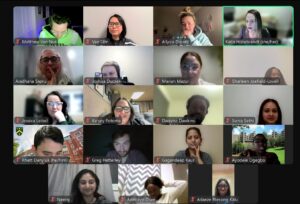
All’s Well that Ends Well

We have come to the end of our course, EC&I 834 but it is the beginning of a whole new phase of instructional design for me.

I felt inadequate at the beginning but gradually overcame that feeling and made some baby strides in the use of technology in designing online course. Links, hyperlinks, H5P, though simple are major feats for me in this course.

Thank you, Dr. Hildebrandt, for your patient guidance throughout this course. Thanks to my colleagues in this course. I learnt a lot from you all.

With confidence, I move forward in designing for online and blended learning. View my Summary of Learning

My Summaries of learning

Hello and welcome to my diary of self-discovery, creativity and course design.

When I signed up for EC&I 834: Designing for online and blended learning, I expected to learn which software makes online training easy, how to navigate Google Classroom like a pro, and maybe enhance my Zoom meetings. Simple, right? Plot twist: I ended creating blogs to document my learning, even though I had used WordPress before. I explored Canvas and delved into H5P and Lumi to bring my course vision to life.

Looking back, I’m proud of how far I’ve come. This journey has been nothing short of empowering. I’ve discovered a creative side I didn’t know I had, and more importantly, I’ve realized that designing online learning is about purpose, inclusion, flexibility, engagement, creating an exceptional learning experience, and, most importantly, it’s about education!

So what’s next? More exploration, course design, and growth. I’m excited to continue building on this foundation and evolving as a course designer and adult educator.

Thanks for reading, and you can also watch my Summaries of Learning.

PS: If you’re on your learning design journey, know it’s okay to start unsure. You’ll be amazed at how far you can go with curiosity, a lot of trial-and-error, and a supportive learning community.

Posted in Uncategorized

Still Learning, Still Curious, Still Human – Final Reflections on EC&I 834

As our journey through EC&I 834: Designing for Online and Blended Learning comes to a close, it feels only right to look back—not just at what we built, but at what we became.

This course wasn’t just about modules and LMSs, or learning how to use H5P and Lumi (though those definitely became our trusty tools). It was about designing with intention. About understanding that education in digital spaces must be inclusive, flexible, and human-centered.

Together, we—Sharleen Joefield-Lovell and Dwayne Dawkins—took on the roles of quest-born creators, building not only a course, but a learning experience.

Our project, PR2025-222: Personal Branding – Image, Etiquette, and Protocol, was built for adult learners navigating career transitions, and it features:

  • A simulation game, Mr. Takahashi, where learners engage in real-life decision making
  • A chatbot tutor named Chuck who offers encouragement and practical coaching
  • Universal design considerations like transcripts, alt text, and offline options
  • A deep integration of HyFlex principles that value learner choice

We reflected not only through blog posts and forums, but through storytelling, creativity, and collaboration. The learning curve was real, but so was the community we built.

🎥 Final Video Artifact

To wrap it all up, we recorded a playful, reflective video artifact—complete with inside jokes, magical transitions, and yes… Chuck makes a cameo.

👉 Watch our Final Reflection Video here: https://youtu.be/xo0glvHpYQc
👉 Try the simulation game Mr. Takahashi: https://canvas.instructure.com/courses/11484942/pages/personal-branding-simulation?module_item_id=129225928


💬 Final Thoughts

Dwayne said it best in our video:

“We thought we were just building a course—but we built a community.”

And to quote Sharleen:

“The real magic was realizing that online doesn’t have to mean impersonal.”

So while this course ends, the adventure continues. We’re still learning. Still curious. Still human.

Thanks for joining us on the journey. 

Posted in Uncategorized

Final Reflections: A Course in Presence, Poise, and Personal Power

“Your personal brand is what people say about you when you’re not in the room.” – Jeff Bezos

Welcome to the final post in my course development journey! I’m proud to introduce the finished prototype of a project I co-developed with Dwayne Dawkins:

🎓 PR2025-222: Personal Branding – Image, Etiquette, and Protocol

This course profile was designed to help learners feel more confident in how they present themselves—whether that’s in the boardroom, on LinkedIn, or at a formal dinner. In today’s interconnected world, social intelligence, cultural fluency, and personal branding aren’t optional, but they’re essential.


📘 Course Overview

Course Title: PR2025-222 – Personal Branding: Image, Etiquette, and Protocol
Delivery Format: Hybrid Online | Hyperflex | Interactive

✨ Course Objectives

By the end of this course, learners will be able to:

  • Develop and articulate a strong personal brand
  • Understand and apply professional image and etiquette
  • Navigate cultural introductions and communication
  • Network effectively online and in-person
  • Demonstrate dining etiquette and global protocol
  • Provide and receive constructive peer feedback

🧱 Course Structure

We divided the course into four interactive modules, each aligned with real-world learning goals.

Module 1: Interaction Intelligence – Polishing Your Soft Skills

  • Enhancing Your Soft Skills
  • Interaction Intelligence: Part 2

Module 2: Dining Etiquette

  • Dining Etiquette
  • Dining Styles & Global Etiquette

Module 3: Foundations of Personal Branding

  • What Makes a Strong Brand?
  • Building Your Personal Brand

Module 4: Skills for Success

  • The Role of Skills in Personal Branding
  • Personal Branding Simulation

The course includes case studies, H5P interactive videos, discussion forums, practical exercises, and a live dining etiquette assessment via video call.


🛠 Behind the Build: How We Created the Course

Creating PR2025-222 blended design, tech, and human-centred pedagogy. Here are the highlights:

✅ AI-Powered Learning

  • Custom avatars helped bring video content to life with realistic, engaging reactions.
  • An AI chatbot was embedded for real-time student support.

✅ Interactive Media

  • H5P tools allowed us to create quizzes, drag-and-drop activities, and simulations that offer instant feedback.
  • Real-world roleplays and etiquette walkthroughs were woven in using embedded videos.

✅ Design for Adult Learners

  • We minimized external links, kept navigation simple, and embedded everything learners needed directly within the course shell.
  • A built-in Google appointment Calendar lets students schedule practical assessments quickly and easily. This calendar is intentionally integrated within the assignments tab of the course.

✅ Inspired by Others

  • We drew inspiration from other high-impact H5P designs and adapted them with our own voice and goals in mind.

🎥 Watch Our Course Walkthrough

Want to explore the course layout and features? Watch our 20-minute screencast walkthrough where we show:

  • Course homepage and intro sequence
  • Module design and key activities
  • Dining etiquette practice exams
  • Student support features

📺 Watch here:
👉 https://youtu.be/sIRSXdYX4rM

Or even play our personal branding simulation game here:

👉https://app.Lumi.education/run/NRZggC


💬 Final Thoughts

Developing this course prototype was more than just a capstone project—it was a journey into reimagining what learning can be when it’s practical, polished, and deeply personal.

Our goal was to equip learners not only with valuable skills but also with the confidence to apply them—whether introducing themselves at a networking event or engaging with a global client. PR2025-222 is designed to help individuals present their best selves in any professional setting.

Thank you for joining us on this journey. Here’s to meaningful communication, authentic personal branding, and a commitment to learning that lasts a lifetime.


👤 Created by:
Dwayne Dawkins & Sharleen Joefield-Lovell
Instructional Designers | Advocates of Polished Presence


Posted in Uncategorized

Feedback and Plan of Action

The feedback received was valuable and provided pragmatic options for implementing new strategies. The insights regarding our course design, module structure, and accessibility have been both encouraging and enlightening. We are especially grateful for the thoughtful evaluations, which are already influencing how we approach the next phase of course development. Below, we outline how we plan to incorporate (or not incorporate) this feedback into Modules 3 and 4, as well as revisions to our existing prototypes.


Summary of Key Feedback and Planned Responses

Course Shell

Strengths:
Feedback affirmed that our course shell is well-organized, easy to navigate, and provides a clear introduction to the course and instructors. The usability and structure were highly commended.

Areas for Improvement & Planned Adjustments:

  • Issue: Some video links were non-functional, and duplicate content was noted.
    Action: All video links will be reviewed and updated to ensure functionality. Redundant content will be removed to streamline the learner experience.
  • Issue: The “Start Here” button currently redirects to an announcement page instead of module content.
    Action: We will reconfigure the button to take students directly to the introductory module.
  • Issue: Instructor contact information was missing from the welcome message.
    Action: Contact details will be added to the welcome message for easy access and support.

Course Modules

Strengths:
Reviewers appreciated the engaging and well-structured content, as well as the alignment with learning outcomes. The use of multimedia and interactive activities was also positively highlighted.

Areas for Improvement & Planned Adjustments:

  • Issue: Some H5P activities created a “double scroll” effect, potentially affecting accessibility.
    Action: These elements will be optimized for better integration within Canvas to eliminate layout issues.
  • Issue: Expectations for synchronous sessions were unclear.
    Action: We will include detailed instructions regarding student preparation, participation methods, and synchronous session goals.
  • Issue: The course profile contained references to both Moodle and Canvas, leading to confusion.
    Action: All platform-specific references will be standardized to reflect Canvas as the selected LMS.

Course Profile

Strengths:
The course profile was praised for its clarity, strong alignment with assignment criteria, and effective use of learner personas. The explanation of the HyFlex model was particularly well received.

Areas for Improvement & Planned Adjustments:

  • Issue: Accessibility accommodations for students with limited bandwidth, EAL learners, and those with minimal tech access were not clearly addressed.
    Action: We will add accommodations such as downloadable resources, transcripts, and asynchronous learning options to support diverse learners.
  • Issue: Expectations for discussion participation were vague.
    Action: Clear guidelines—such as word limits, video/audio alternatives, and peer response requirements—will be provided to ensure consistency and engagement.

Reflection on Accessibility and Equity

Our Week 7 discussions prompted a deeper reflection on how we can make the course more inclusive and equitable. While flexibility is embedded into our HyFlex approach and content formats, we identified several areas for further enhancement:

  • Digital Access & Bandwidth:
    We will provide downloadable materials, transcripts for videos, and text-based alternatives for multimedia to support students with connectivity limitations.
  • Language & Comprehension Support:
    Glossaries, simplified content versions, and language support tools will be introduced to assist EAL learners. Discussion forums will also serve as an alternative to live participation for students who may need more time to process and respond.
  • Instructor & Peer Interaction:
    We will improve clarity around collaborative exercises and increase instructor presence in forums to encourage active participation. Interactive components will be designed with more structure to help students apply course concepts effectively.

Conclusion

The feedback we received has been instrumental in helping us refine our approach. As we move into the development of Modules 3 and 4, we remain committed to improving the course’s accessibility, clarity, and learner engagement. Our goal is to create a supportive and inclusive learning environment that meets the diverse needs of all students.

Posted in Uncategorized

Fostering Student Interaction in Online Learning: Instructional Strategies for the Personal Branding – Image, Etiquette, and Protocol Course

Deliberately designing engaging student interactions is essential for a thriving online learning environment. As an instructional designer, my approach to developing the Personal Branding – Image, Etiquette, and Protocol course integrates a variety of interaction methods to support learner engagement, promote collaboration, and enhance learning outcomes. These methods are deliberately selected to support cognitive, social, and teaching presence within the online environment.

Integrated Forms of Learner Interaction

1. Structured Discussion Forums for Course-Based Activities

To promote meaningful peer interaction, structured, topic-specific discussion forums will be embedded throughout the course. These forums are designed to guide students in engaging with core concepts, such as:

  • Reflecting on key personal branding principles
  • Sharing professional and personal experiences
  • Offering peer-to-peer feedback
  • Collaborating on real-world problem-solving tasks related to branding, etiquette, and protocol

Rationale:

  • Encourages deep reflection and higher-order thinking
  • Supports asynchronous access, allowing flexibility in participation
  • Enables peer learning and diverse perspectives in knowledge construction

2. Open Discussion Board (Community Forum)

An informal, open discussion space will be provided for general questions, peer advice, and idea sharing. Unlike the structured forums, this board serves as a community hub where learners and instructors can connect more freely.

Rationale:

  • Reduces isolation by building a sense of community
  • Encourages ongoing dialogue beyond course content
  • Supports informal learning and real-time problem-solving

3. Synchronous Video Sessions via Google Meet

Live video sessions will be scheduled periodically to facilitate instructor-learner interactions. These sessions will provide opportunities for:

  • Real-time clarification of course concepts
  • Personalized feedback on assignments
  • Deeper engagement with complex or sensitive topics
  • Reinforcement of instructor presence and support

Rationale:

  • Humanizes the online learning experience
  • Provides personalized support and scaffolding
  • Enhances engagement through direct communication

Designing for Inclusive, Safe, and Supportive Interactions

To ensure a positive and meaningful learning experience, the course will incorporate several community-building and support strategies:

1. Community and Connection Building

  • Instructor Introduction Video to establish approachability and set the tone for the course
  • Student Introductions & Icebreakers to encourage learners to share their goals and backgrounds

2. Inclusive and Respectful Communication

  • Clear netiquette guidelines to set expectations for respectful online interactions
  • Recognition of student contributions to foster participation and belonging
  • Dedicated spaces for students to share challenges and offer peer support

3. Instructor Presence and Communication

  • Weekly announcements and personalized email check-ins to maintain engagement
  • Prompt responses in discussion forums (within 24–48 hours)
  • Occasional video updates to reinforce instructor visibility and care

4. Assessment of Interaction and Engagement

  • Participation in forums evaluated on thoughtfulness, relevance, and peer interaction
  • Contributions to open boards factored into formative assessments
  • Video session attendance encouraged, with flexibility for learners in different time zones

By intentionally designing these interaction strategies, we aim to create a rich, engaging, and learner-centered online environment. Students will not only gain practical skills in personal branding but also benefit from a connected and empowering digital learning community.

Reference:
Brusini, A. (2020, June 17). Building community in an online course. Johns Hopkins University, Center for Educational Resources. https://ii.library.jhu.edu/2020/06/17/building-community-in-an-online-course/

Posted in Uncategorized

Still Learning, Still Curious, Still Human – Final Reflections on EC&I 834

As our journey through EC&I 834: Designing for Online and Blended Learning comes to a close, it feels only right to look back—not just at what we built, but at what we became.

This course wasn’t just about modules and LMSs, or learning how to use H5P and Lumi (though those definitely became our trusty tools). It was about designing with intention. About understanding that education in digital spaces must be inclusive, flexible, and human-centered.

Together, we—Sharleen Joefield-Lovell and Dwayne Dawkins—took on the roles of quest-born creators, building not only a course, but a learning experience.

Our project, PR2025-222: Personal Branding – Image, Etiquette, and Protocol, was built for adult learners navigating career transitions, and it features:

  • A simulation game, Mr. Takahashi, where learners engage in real-life decision making
  • A chatbot tutor named Chuck who offers encouragement and practical coaching
  • Universal design considerations like transcripts, alt text, and offline options
  • A deep integration of HyFlex principles that value learner choice

We reflected not only through blog posts and forums, but through storytelling, creativity, and collaboration. The learning curve was real, but so was the community we built.

🎥 Final Video Artifact

To wrap it all up, we recorded a playful, reflective video artifact—complete with inside jokes, magical transitions, and yes… Chuck makes a cameo.

👉 Watch our Final Reflection Video here: https://youtu.be/xo0glvHpYQc
👉 Try the simulation game Mr. Takahashi: https://canvas.instructure.com/courses/11484942/pages/personal-branding-simulation?module_item_id=129225928


💬 Final Thoughts

Dwayne said it best in our video:

“We thought we were just building a course—but we built a community.”

And to quote Sharleen:

“The real magic was realizing that online doesn’t have to mean impersonal.”

So while this course ends, the adventure continues. We’re still learning. Still curious. Still human.

Thanks for joining us on the journey. 💫

Posted in Uncategorized

EC&I 834 Course Wrap Up

Last night was our final class, and I was supposed to submit my course summary then. Unfortunately, I ran into an issue with my summary video—it couldn’t complete rendering in time. I reached out to the Animaker support team for help, and I was eventually able to download the video for sharing this morning.

The last class was emotional but fun. It was a great opportunity to watch so many thoughtful, creative, and hilarious summaries from my classmates. My personal learning summary wasn’t anything fancy—just a personal reflection on what I’ve learned and the challenges I faced, which ultimately helped deepen my learning experience.

I used Animaker to create my video because I’m familiar with the platform. However, with all the recent updates, it still took me a while to complete it. Luckily, I still have a Basic Plan subscription, which allowed me to make a five-minute video. I chose to use text instead of audio, thinking it would be easier for everyone to read rather than listen to my voice.

These past 13 weeks have been an incredible learning journey. While five minutes isn’t nearly enough to capture everything I’d like to say, the lessons and experiences I’m taking away will stay with me for a lifetime.

Thank you, Dr. Hildebrandt, for such a fantastic course. And thank you to all my classmates for your genuine contributions to my blog, course profile, and course prototype. Without each of you, this course wouldn’t have felt as complete and meaningful as it did.

Wishing you all the very best in your future learning and teaching careers—may you continue to grow, inspire, and make a difference wherever you go!

Learning summary of Online & Blended Learning – My EC&I 834 Journey

When I enrolled in EC&I 834, I had a basic understanding of digital tools from my own learning experiences—but I had never ventured into the world of designing online or blended learning experiences myself. As someone who works closely with young children, I often wondered: Can digital learning engage younger pupils meaningfully? Today, after completing this course, I can say with confidence—yes, it absolutely can!

Throughout the term, EC&I 834 pushed me to think beyond traditional classroom practices. I was introduced to frameworks like ADDIE which helped me design learning with intentional structure and clear outcomes. More than just theory, I had the chance to dive into practical tools like Lumi and H5P, which brought interactivity and creativity into my course prototype.

One of the most rewarding parts of this course was building a Grade 3 Science module. I used Canvas to design a visually engaging and age-appropriate course that prioritized simplicity and accessibility. Integrating interactive elements like quizzes, drag-and-drop activities, and videos allowed me to create a more dynamic experience for pupils—especially those learning English or navigating bandwidth challenges at home.

We want to pay particular attention to how we use Discord. It evolved into a support hub where helpful conversations occurred outside of the scheduled classroom, inquiries were promptly answered, and resources were freely distributed. Sometimes I was able to solve my problems just by reading what other individuals had posted. It acted as a reminder that community and connection can still be fostered through online education with proper design.

Upon reflection of this incident, a number of noteworthy points emerge:

  • In addition to technology, inclusive practices, student-centered approaches, and thoughtful design are all important components of effective online learning.
  • Equity and accessibility are very important. It is crucial to design with all learners in mind; it is not an option.
  • Online community creation is both feasible and effective. From reviews from peers to informal
  • Accessibility and equity matter deeply. It is essential that all learners be considered while designing. • Online community development is both feasible and effective. These exchanges, which included everything from informal conversations to peer reviews, enhanced my educational experience.

In the future, I can’t wait to apply this new understanding to my ongoing student work.  I want to hone my abilities in producing interesting and accessible information and keep learning more about Universal Design for Learning. My love for creating helpful digital learning environments has grown as a result of this learning.

Many thanks to all those who have shared in our trip! I’m happy of what we’ve all achieved and excited to watch how we develop as teachers going forward.

Check out my final summary video here

https://youtu.be/edYeaQBJyHA

Let’s continue to develop, communicate, and produce together. I wish you all the very best!

Posted in Uncategorized